
South Florida Reserve Studies
Reserve Studies Prepared by a Licensed Professional Engineer
A reserve study is a long-term funding plan for your community’s major shared components such as roofing, painting, pavement, elevators, mechanical systems, and more. Criterium-Cromer Engineers prepares reserve studies in accordance with applicable Florida requirements and recognized industry standards for condominium and homeowner associations across Miami-Dade, Broward, and Palm Beach counties, always overseen by a licensed P.E.
- Prepared and signed by a licensed Professional Engineer, not a third-party inspector
- On-site inspection with component-level cost and useful-life analysis
- Board-ready report built for Florida compliance and lender or resale review
Licensed P.E. Oversight
A Florida-licensed Professional Engineer signs and stands behind every report.
Florida Compliance Expertise
Grounded in Florida Statute 718.112(2)(g) and current SIRS requirements.
Board-Ready Reports
Clear tables, photos, and funding options your board can act on.
The Basics
What is a Reserve Study, and Why Your Association Needs One
A reserve study projects when major shared components will need repair or replacement and how much it will cost, so your association can set aside funds gradually instead of relying on a special assessment. It covers items like roofing, paving, painting, elevators, pool equipment, and mechanical systems.
Florida law also requires qualifying condominium buildings three habitable stories or higher to complete a Structural Integrity Reserve Study (SIRS), focused specifically on the structural integrity and safety components identified by Florida Law. Many boards handle both in one coordinated engagement.
Used for Long-Term Capital Planning
- Comprehensive evaluation of common area components
- Useful life and replacement cost estimates
- Straight-line and pooled funding options
- Supports multi-year budgeting and forecasting
- Typically updated every 3 to 5 years
- May be partially waived by membership vote
Required for Qualifying Buildings
- Applies to buildings three habitable stories or higher
- Must be completed at least every 10 years
- Established under Florida Statute 718.112(2)(g)
- Mandatory funding of SIRS items under Florida law
- Compliance-driven format and reporting
- Cannot be waived by membership vote
Many associations require both studies. We coordinate inspections and reporting in a single engagement to keep things efficient. Learn more about SIRS.
Why It Matters
The Cost of Skipping a Reserve Study
Without a funded reserve plan, associations risk sudden special assessments, deferred maintenance, and complications during resale or refinancing. A current reserve study protects owners and gives your board a defensible record for decisions.
- Avoid unplanned special assessments on owners
- Stay ahead of Florida reserve funding and SIRS requirements
- Support lender and buyer due diligence at resale
- Give the board a documented basis for budget decisions
Not sure if your reserve study is current or compliant?
We’ll review your property and any prior study before scoping a proposal.
Scope
What’s Included in Our Reserve Studies
What We Inspect
- Roofing, waterproofing, and building envelope
- Paving, sidewalks, and site elements
- Elevators and mechanical systems
- Fire alarm and life-safety systems
- Structural and load-bearing components
- Security, access control, and site lighting
- Pools, amenities, and painting
What the Report Includes
- Executive summary with current reserve position and funding outlook
- Component inventory with quantities, locations, and cost basis
- Remaining useful life for each component
- Recommended annual contributions under each funding methodology
- Community profile, methodology, and standards and limitations sections
- Clear report with photos, tables, and supporting appendices
Our Process
From Proposal to Final Report
Proposal and Scope
We review the property, available information, and your planning needs to confirm the appropriate study scope, fee, and schedule.
Response within 1 business day
Engineer-Led Site Inspection
A visual inspection of applicable common components is conducted by, or under the responsible charge of, a Florida-licensed Professional Engineer.
Scheduled around site access
Component Analysis
We develop the component inventory, remaining useful life estimates, and repair or replacement costs using observed conditions, available documentation, and recognized cost data.
Begins after the inspection
Funding Plan and Draft Report
We prepare 30-year funding projections, supporting tables, and a draft report based on the selected funding methodology and applicable requirements.
Typically 2 to 3 weeks after inspection
Board Review and Revisions
We review the findings and funding recommendations with the board or management team, answer questions, and incorporate appropriate revisions.
After draft issuance
Final Report and Support
You receive the final signed and sealed report. We remain available to assist with questions about the findings, funding plan, and future updates.
Issued after board confirmation
Service Area
Where We Work
We serve communities throughout Miami-Dade, Broward, and Palm Beach counties, including Miami, Fort Lauderdale, Hollywood, Pembroke Pines, Boca Raton, and West Palm Beach. We also provide Transition Studies and commercial building inspections.
Reserve Study Cost
Fees typically start in the low thousands and depend on property size, component count, and complexity.
Read more: How Much Does a Reserve Study Cost in Florida?
Why Criterium-Cromer
Engineer Accountability, Not Just an Inspection
A reserve study is only as reliable as the person signing it. Every Criterium-Cromer report is prepared under the direct oversight of a licensed Professional Engineer, with direct access to the person responsible for the analysis.
We prepare comprehensive reserve studies and Florida-compliant SIRS reports for condominium and HOA communities across South Florida, backed by the Criterium Engineers network, established in 1957 with 850,000+ buildings evaluated nationwide.

A licensed Professional Engineer and South Florida native, Casey works directly with condominium and HOA boards on reserve studies and Structural Integrity Reserve Studies, no call center, no hand-offs.


 Trustindex verifies that the original source of the review is Google.
  Trustindex verifies that the original source of the review is Google.
  Trustindex verifies that the original source of the review is Google.
  Trustindex verifies that the original source of the review is Google.
  Trustindex verifies that the original source of the review is Google.
  Trustindex verifies that the original source of the review is Google.
  Trustindex verifies that the original source of the review is Google.
  Trustindex verifies that the original source of the review is Google.
 Frequently Asked Questions
Reserve Study FAQ
What’s included in a reserve study?
An inspection of major components, life expectancy estimates, cost projections, and funding plans.
How is a reserve study different from a SIRS?
A Structural Integrity Reserve Study (SIRS) is a Florida-specific study that focuses on structural and safety-critical elements. A reserve study covers all major common elements, not just those required under SIRS.
How often should we update our reserve study?
Every 3 to 5 years, or sooner if there are major repairs, cost changes, or new legal requirements.
How much does a reserve study cost?
Most cost a few thousand dollars and up, depending on the property. Learn more here.
How long does the process take?
Typically 2 to 4 weeks from site visit to final report.
Who performs the reserve study?
All of our studies are overseen by a licensed Professional Engineer for accuracy and compliance.
Report Excerpts
See Inside an Actual Reserve Study
Component List
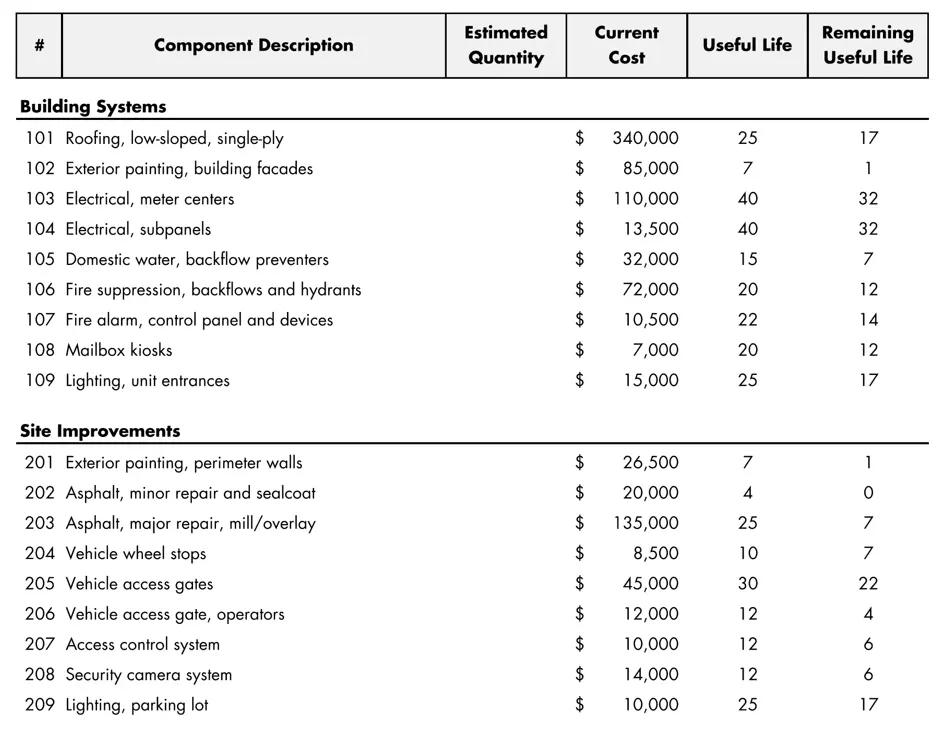
The component list is the foundation of a reserve study. It identifies the major common area components evaluated, along with their estimated remaining life, replacement cost, and projected timing. This excerpt illustrates how components are organized and documented to support long-term planning and defensible funding recommendations.
Straight Line Funding
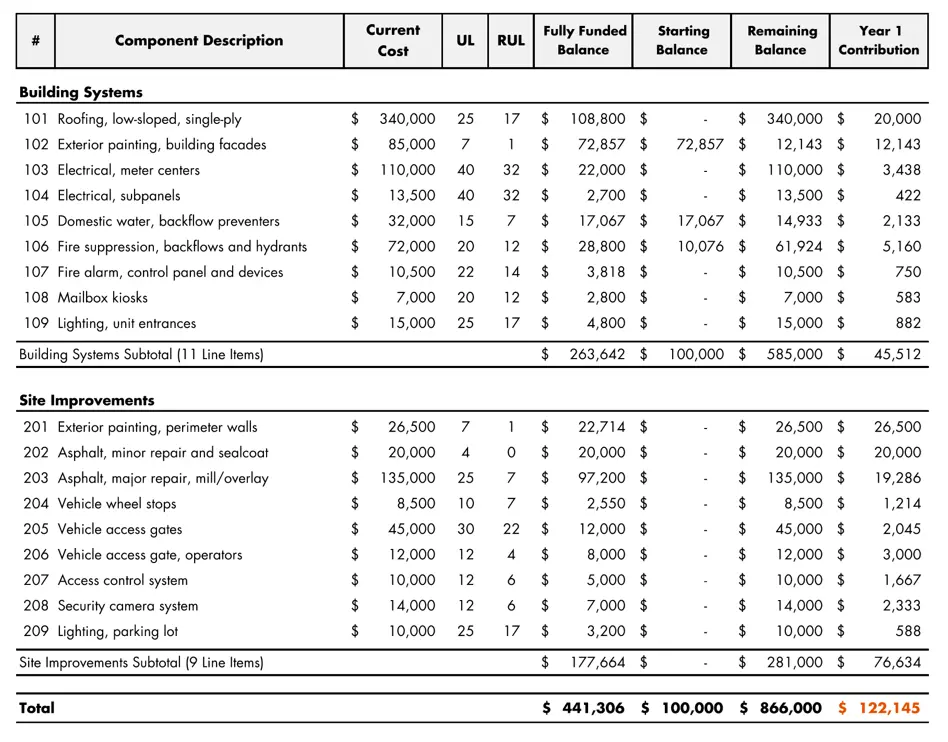
Straight line funding allocates reserve contributions evenly over time based on projected repair and replacement costs. This approach is simple and predictable, but may not reflect how expenses actually occur. The table below shows a straight line funding projection and how annual contributions compare to anticipated expenditures. See our Straight-Line vs. Pooled Reserve Funding comparison guide for more information.
Pooled Funding
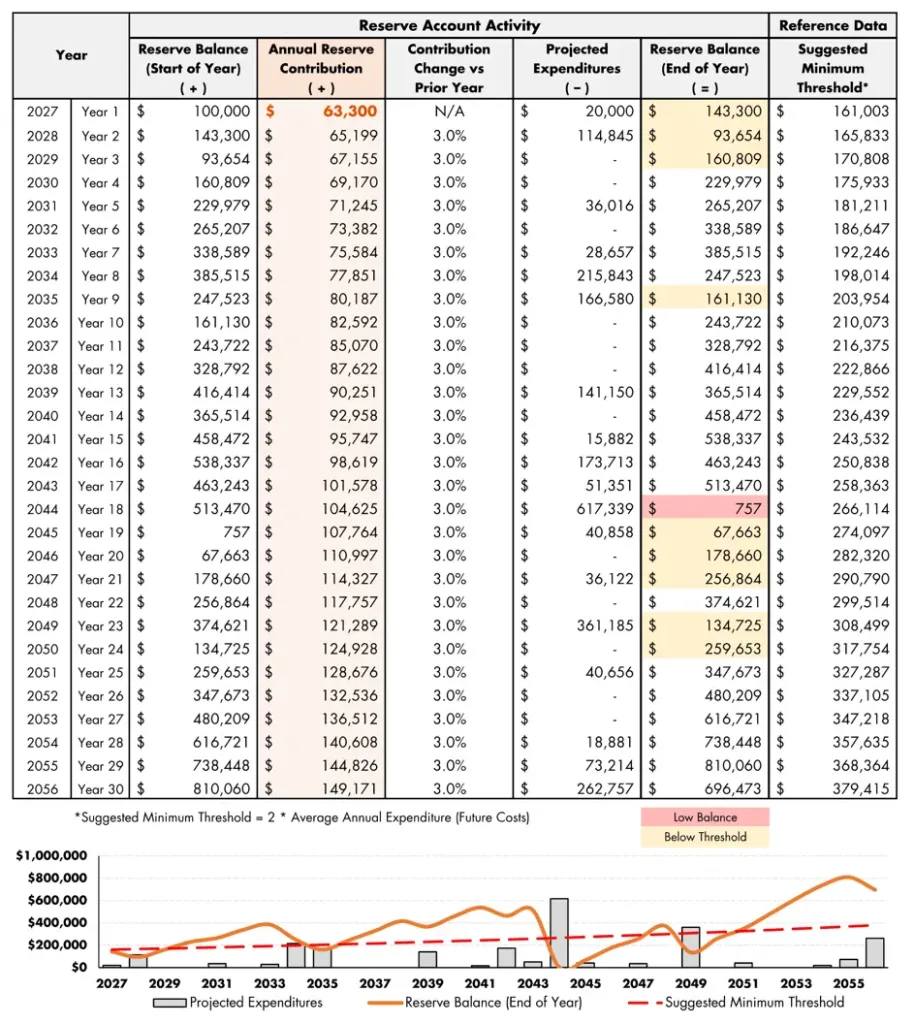
Pooled funding evaluates all reserve components together rather than funding each item individually. This method allows available funds to be used where needed, when needed. This excerpt shows how pooled funding can smooth contribution requirements while still accounting for future capital obligations. See our Straight-Line vs. Pooled Reserve Funding comparison guide for more information.
Request a Reserve Study Proposal
Tell us about your community and we’ll provide a fixed-fee proposal with recommended scope and schedule.
Prefer to talk? Call (305) 250-2936 or contact us.