
If your condominium association recently received a letter from the DBPR’s Florida Division of Condominiums, Timeshares, and Mobile Homes regarding an alleged failure to complete a required Structural Integrity Reserve Study, you are not alone. Many Florida condominium associations appear to be receiving similar notices where no completed SIRS is on record or available to the Division.
If your association has not yet completed a SIRS, the letter usually creates two immediate issues: first, responding to DBPR by the deadline in the letter; and second, moving quickly to get the SIRS process underway.
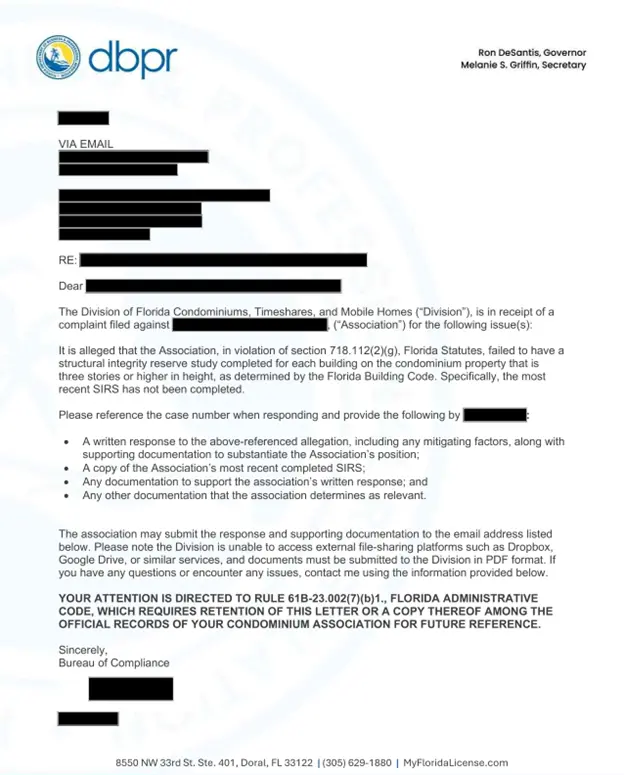
Problem 1: The DBPR Response Deadline
The letter gives your association a specific deadline to submit a written response and supporting documentation. Based on the notice itself, DBPR is generally asking for a written response to the allegation, a copy of the association’s most recent completed SIRS, and any other documents the association considers relevant.
If your association does not yet have a completed SIRS, that does not mean you should wait until the study is finished before responding. In many cases, the most practical approach is to provide a timely written response that explains the current status, identifies any relevant facts, and documents the steps the association is taking to address the issue.
Because this is a regulatory response, the association should strongly consider having its attorney prepare or review the submission before it is sent.
Problem 2: Getting the SIRS Done
For many condominium associations, the larger issue is that the SIRS still needs to be completed. Under Florida law, a residential condominium association must have a Structural Integrity Reserve Study for each building that is three habitable stories or higher in height, as determined by the Florida Building Code.
A SIRS is a budget planning tool focused on major structural and safety related reserve components. At a minimum, it addresses items such as the roof, structure, fireproofing and fire protection systems, plumbing, electrical systems, waterproofing and exterior painting, windows and exterior doors, and certain other qualifying items.
The study is based on a visual inspection. Under the statute, the visual inspection portion must be performed or verified by a Florida-licensed engineer, a Florida-licensed architect, or certain credentialed reserve specialists. For many associations, an engineering-led process is the most practical path, especially where building condition, scope interpretation, and reserve planning need to be clearly documented.
If your association is starting from scratch, the general sequence usually looks like this:
- Engage a qualified provider and confirm scope, fee, and timing
- Gather existing records such as prior reserve studies, reserve balances, repair history, and governing documents
- Schedule the site inspection as soon as possible
- Complete the draft study and internal review
- Finalize the report and prepare any follow-up documentation needed by the association
The sooner that process starts, the easier it is to show DBPR that the board is acting promptly and in good faith.
What the Letter Does Not Necessarily Mean
Receiving a DBPR notice does not automatically mean the association has no possible response or defense. In some cases, an association may already have a reserve study that needs to be reviewed to determine whether it satisfies the statutory SIRS requirements. In other cases, the association may have been planning to complete the SIRS together with a milestone inspection if that timing is permitted under the statute.
Still, the letter should not be ignored. Even if many associations are in a similar position, each association should treat its own response and compliance path seriously.
What Not to Do
Do not ignore the letter. Do not assume the issue will resolve itself. Do not wait until the response deadline has passed to begin contacting providers. And do not assume that an older reserve study automatically qualifies as a compliant SIRS without reviewing it carefully.
A Note on Existing Reserve Studies or Prior SIRS Reports
If your association already has a reserve study or believes a SIRS was completed, it is worth verifying whether the document actually meets the statutory requirements before sending it to DBPR. A report may still need updates if it does not clearly address the required components, estimated remaining useful life, estimated replacement cost or deferred maintenance expense, and reserve funding schedule.
This is one reason boards often benefit from both legal review and technical review before responding.
Recommended Next Steps
- Have association counsel draft or review the written response to DBPR
- Confirm whether your building is subject to the SIRS requirement
- Determine whether the association already has a study that may qualify, or whether a new SIRS is needed
- Engage a qualified professional promptly and document the engagement date, inspection date, and expected timeline
- Retain the DBPR letter and related correspondence in the association’s official records
If your association needs to move quickly, the most helpful first step is usually a prompt review of the property type, building height, existing documents, and likely timeline to completion.
Need Help Navigating the DBPR Letter or Starting Your SIRS?
If your association received a DBPR notice and is unsure how to proceed, the first step is understanding your current position and timeline. That includes confirming whether a SIRS is required, reviewing any existing studies, and determining how quickly a compliant study can be completed.
We assist condominium associations throughout South Florida with:
- Reviewing existing reserve studies to determine SIRS compliance
- Confirming whether your building is subject to the SIRS requirement
- Providing clear scope, fee, and timeline for completing a SIRS
- Coordinating inspections and delivering engineer-led reserve studies
If you need to respond quickly, we can typically review your situation and provide next steps within one business day.
Request a SIRS Review or Proposal
Frequently Asked Questions
Can we respond to DBPR before the SIRS is finished?
In many cases, yes. The response deadline and the completion of the SIRS are related but separate issues. If the association is actively engaging a qualified provider and moving forward, that progress may be important to document in the written response. The association’s attorney should guide that submission.
Who can perform a SIRS in Florida?
Under the statute, the visual inspection portion of the SIRS must be performed or verified by a Florida-licensed engineer, a Florida-licensed architect, or certain credentialed reserve specialists. The appropriate provider depends on the property, the scope, and the complexity of the issues involved.
Is a milestone inspection the same as a SIRS?
No. They are separate requirements under Florida law. They may sometimes be completed at the same time under certain circumstances, but one does not automatically replace the other.
What if our building is under three stories?
The SIRS requirement applies to residential condominium buildings that are three habitable stories or higher in height. If there is any doubt about whether the requirement applies to your property, that should be confirmed carefully before responding.
What if we already have a reserve study?
A prior reserve study may or may not satisfy the current SIRS requirements. The document should be reviewed to determine whether it addresses the required statutory components and includes the information needed for a compliant SIRS.
How long does a SIRS take?
The timeline depends on the size and complexity of the property, the availability of records, and scheduling. For many associations, the process takes at least a few weeks once the engagement and inspection are underway. Starting early creates more flexibility and gives the association more to document in its DBPR response.
Do we need an attorney, an engineer, or both?
They serve different roles. The written response to DBPR should generally involve the association’s attorney. The SIRS itself requires a qualified technical provider. In many cases, both are needed to address the issue properly and efficiently.
- Learn more about Structural Integrity Reserve Studies (SIRS) and how they apply to Florida condominium associations.
- If you are unsure whether your association is compliant, you can request a free SIRS review to evaluate your current status.
- For a broader overview, see our guide to reserve studies for HOAs and condominiums.
- Compare funding approaches in our 2026 Guide for for Florida Condo Boards.
- For the statutory requirements, refer to Florida Statutes Section 718.112(2)(g).
- Additional guidance and FAQs are available from the Florida DBPR SIRS reporting page.
- Industry standards for reserve studies can be found through the Community Associations Institute (CAI).