Florida Structural Integrity Reserve Study (SIRS):
2026 Compliance Guide for Condominium Associations
Last updated: January 2026
Overview
Florida’s Structural Integrity Reserve Study (SIRS) is a mandatory condominium reserve study focused on the structural safety and long-term reserve funding of condominium buildings three stories or higher. Associations that need a compliant SIRS prepared under the responsible charge of a Professional Engineer can request a proposal here. Enacted in response to the 2021 Surfside condominium collapse, SIRS requirements were written into the Florida Condominium Act (Florida Statutes Chapter 718). This guide explains what a SIRS is, how it differs from a traditional reserve study, and what South Florida condominium boards and property managers need to know to comply with 2026 SIRS deadlines and funding requirements.
What Is a Structural Integrity Reserve Study (SIRS)?
A Structural Integrity Reserve Study (SIRS) is defined in Florida law as “a study of the reserve funds required for future major repairs and replacement of the condominium property”. In simple terms, it’s a comprehensive evaluation of key building components (structural and safety-related systems) to determine their remaining useful life, the cost to repair or replace them, and a funding plan to ensure the association reserves enough money for those future needs.
Florida’s SIRS requirement applies to residential condominiums (and co-ops) that are three or more stories in height. The SIRS must be updated at least every 10 years for each such building. This study became legally required in Florida as of 2022 (via Senate Bill 4-D), and was refined by subsequent legislation in 2023 and 2024 (SB 154 in 2023 and HB 913 in 2024). In practice, a SIRS functions as a statutorily required reserve study for structural components, combining a limited visual inspection with long-range financial planning for major structural repairs.
Purpose
The SIRS is designed to prevent tragic structural failures and financial crises. By identifying critical building issues in advance and planning for their repairs, condo associations can avoid the kind of deferred maintenance that leads to surprise special assessments or unsafe conditions. In South Florida coastal environments, including Miami-Dade, Broward, and Palm Beach counties, this proactive approach is especially vital: salt air, high humidity, hurricanes, and aging high-rises all put extra stress on building structures.
SIRS vs. Traditional Reserve Studies: Key Differences
Scope of Components
A traditional reserve study covers all capital components of an association (for example: clubhouses, landscaping, pool equipment). A SIRS focuses only on the core structural and safety components defined by law (see the next section for the specific list of SIRS components).
Structural Emphasis
The SIRS was developed to ensure that condominium buildings three or more stories high are financially prepared to maintain critical structural elements and systems in safe condition. Non-structural components (like cosmetic or recreational items) are not required in a SIRS. However, associations may still include them in a combined report for long-term planning, ideally separating mandatory structural items from non-mandatory items in the funding plan.
Legal Requirement
Conducting a SIRS and funding the reserves it recommends is mandated by Florida law. Florida Statutes §718.112(2)(g) requires SIRS for qualifying condos, meaning compliance is not optional.
No Waiver of Funding
In a traditional reserve study, Florida condo owners could vote to waive or reduce reserve contributions for various components. SIRS has stricter rules. As of budgets adopted January 1, 2025 or later, owners can no longer waive or reduce funding of the reserves for the SIRS-required items. Florida law now requires fully funded reserves for structural items identified in the SIRS. Other non-structural reserve items can still be waived by the membership if desired, but boards should weigh that decision carefully. This requirement fundamentally changes how Florida condominium reserve funding is handled for structural components.
Professional Oversight
A standard reserve study might be done by a reserve consultant without specific licensure requirements. A SIRS must be performed or verified by a licensed engineer or architect, or a qualified reserve specialist credentialed by the Community Associations Institute (RS) or the Association of Professional Reserve Analysts (PRA). This is intended to ensure appropriate expertise for the visual inspection of structural elements.
Baseline Funding Plan
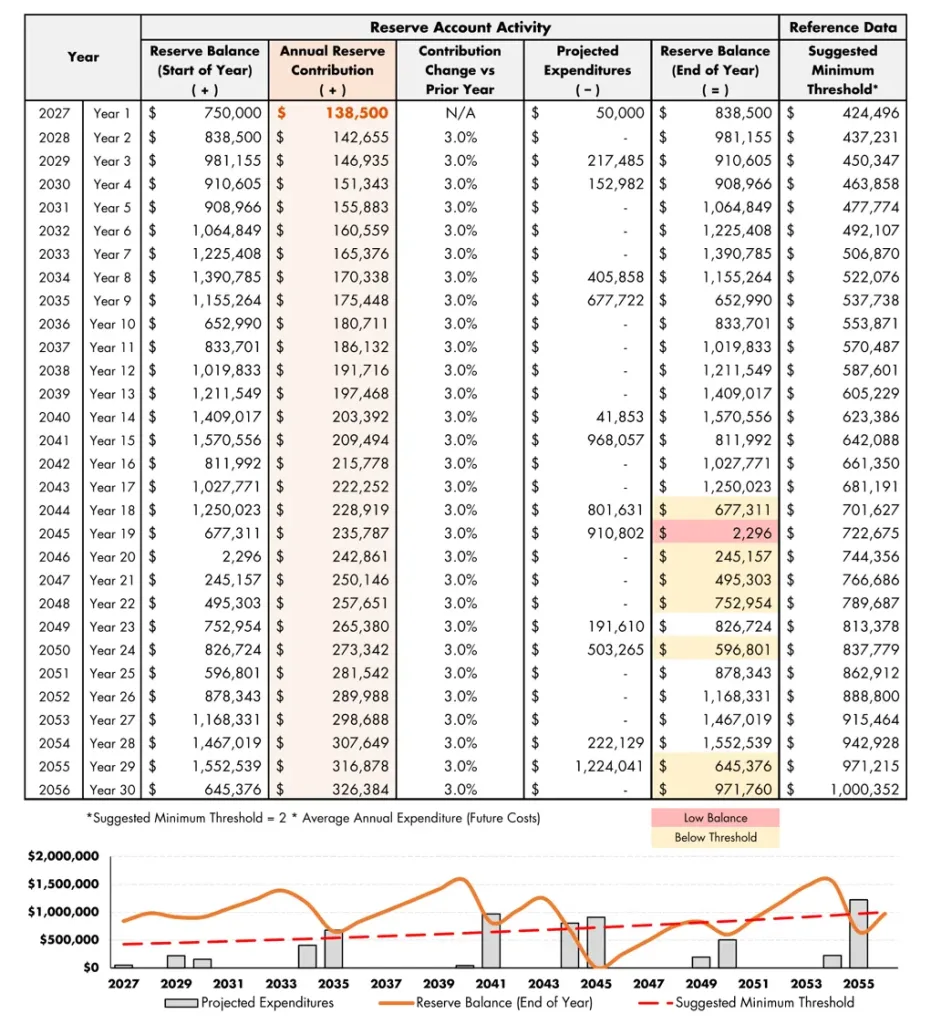
Florida’s SIRS should include a baseline funding plan: a schedule of reserve contributions intended to ensure the reserve account for each structural item does not fall below zero during the projected timeline. Traditional reserve studies often provide funding plans, but the baseline requirement for structural items is now an explicit standard in Florida. Boards reviewing the funding approach may also benefit from understanding common reserve funding methods such as straight-line funding and pooled reserve funding.
Components Covered by a SIRS
Florida law explicitly defines the SIRS component list, focusing on building systems that directly affect structural integrity, life safety, and building envelope performance. According to §718.112(2)(g), a SIRS must at minimum include a study of the following eight components:
- Roof: The main roof system of the building.
- Structure: The building’s structural systems, including load-bearing walls, columns, foundations, and other primary structural members.
- Fireproofing and Fire Protection Systems: Fireproofing of structural elements and fire protection systems (for example: fire sprinklers).
- Plumbing: The main plumbing system (common piping for water supply and waste).
- Electrical Systems: The main electrical wiring, panels, and systems serving the building.
- Waterproofing and Exterior Painting: Measures that protect the structure from water intrusion, including exterior painting, weatherproofing, and sealants.
- Windows and Exterior Doors: All exterior-facing windows and doors, which are part of the building envelope.
- Other Structural Components: Any other item with a deferred maintenance or replacement cost exceeding the statutory threshold (currently $25,000) and whose failure could affect one of the above systems.
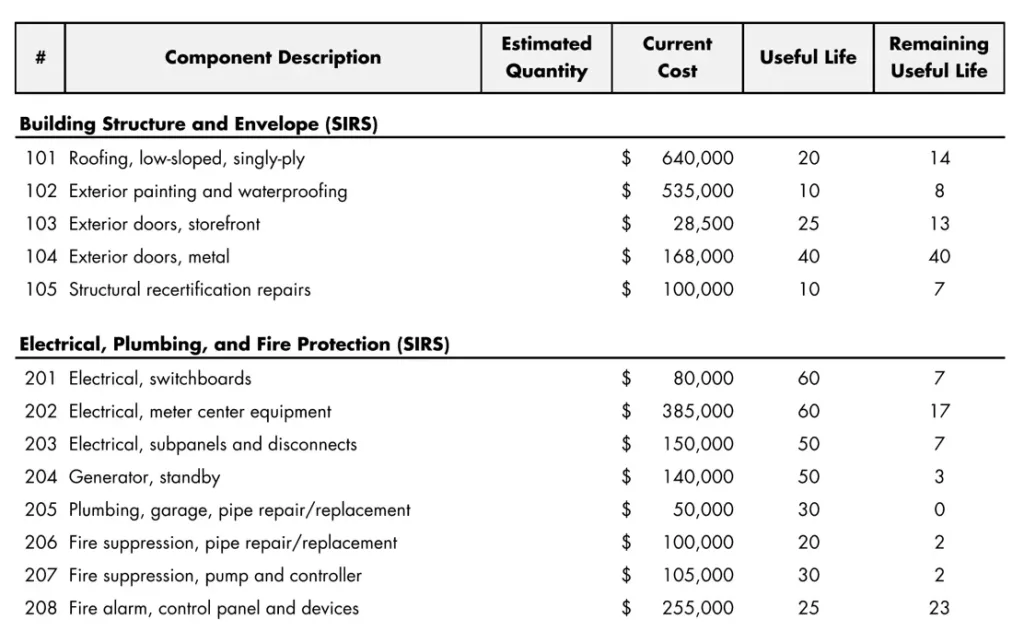
These components reflect the common elements vital to a building’s safety and habitability. For each component, the study evaluates condition, remaining life, and required reserve funding. If a building has additional structural features (for instance: a seawall or parking garage that is part of the condominium property), those may be included if they meet the threshold and affect structural integrity.
Local Tip: South Florida Building Exposure
In coastal condominiums, pay close attention to waterproofing, concrete structures, and windows. Salt exposure can accelerate corrosion and deterioration, making balconies, columns, and façade elements more prone to damage. The SIRS visual inspection should document observed conditions and the funding plan should reflect realistic maintenance and restoration cycles.
Who Can Prepare a SIRS (Qualifications)
Engineer or Architect
The visual inspection portion of the SIRS must be performed or verified by a Florida-licensed professional engineer (P.E.) or architect experienced in structural and building systems. Boards and managers can verify licensure through the Florida Board of Professional Engineers license search (which links to the state license lookup).
Reserve Specialist or Analyst
Florida also allows certain reserve professionals to conduct SIRS, including those certified as Reserve Specialist (RS) by CAI or Professional Reserve Analyst (PRA) by APRA. In practice, these specialists often handle the financial analysis while an engineer or architect supports or verifies the structural observations.
Team Approach
A SIRS is often completed by a team, such as a reserve study provider working with a structural engineer. Florida law allows a team approach as long as the appropriate licensed professional signs off on applicable portions of the work.
Frequency: When and How Often a SIRS Is Required
Many associations search for this requirement as “how often is a SIRS required in Florida” or “SIRS update frequency.
Required Update Interval
A SIRS must be completed at least every 10 years for each covered building.
New Condominiums
For new condominiums, the first SIRS is generally due within 10 years of the building’s creation (often tied to the recording of the declaration, and sometimes approximated to early ownership timeline milestones). After that, it repeats every 10 years.
Existing Condos and the Initial Deadline
All owner-controlled condo associations existing on or before July 1, 2022 must complete their first SIRS by December 31, 2025.
Coordination with Milestone Inspections
If your building’s milestone inspection is due on or before December 31, 2026, Florida law allows the association to coordinate the SIRS with the milestone inspection and deliver both together. This coordination cannot extend the SIRS beyond December 31, 2026. For DBPR guidance on milestone inspections and SIRS, see DBPR Condominium Information and Resources: Inspections.
Using Recent Prior Inspections
If a qualifying inspection was performed within the past five years and it meets the SIRS requirements, it may be accepted in place of a new visual inspection. Whether an older report qualifies is fact-specific and should be evaluated by your professionals.
What a SIRS Report Must Include
To be compliant with Florida Statutes (§718.112(2)(g)), a SIRS should produce a clear written report that includes:
A compliant SIRS report must include both a physical condition assessment of structural components and a long-term reserve funding schedule.
- Itemized Component List: Identification of each condominium property item inspected as part of the study.
- Visual Inspection Findings: Summary of observed condition and notable deficiencies, if any.
- Estimated Remaining Useful Life: Estimated remaining years before major repair or replacement is needed for each component.
- Estimated Replacement Cost or Deferred Maintenance Expense: Current cost estimates for replacement or major repairs.
- Reserve Funding Plan: A recommended funding schedule intended to provide sufficient funds when needed, consistent with the required baseline approach.
- Separation of Mandatory vs. Non-mandatory Items: Clear separation if non-required components are included.
- Executive Summary: High-level findings, key risks, and funding implications.
- Professional Credentials: Identification of who performed or verified the work and required certifications or licensure.
Owner Notice and Availability
Within 45 days of completing the SIRS, the board must notify unit owners that the report is available for review and provide a copy upon request. If the association maintains an official website for owner access, the report must be posted there.
DBPR Reporting
Florida requires associations to electronically report completion of the SIRS through the DBPR portal within 45 days, using the applicable reporting process. See DBPR: SIRS Reporting and Database.
Deadlines and Compliance Milestones
December 31, 2025: Initial SIRS Deadline
All Florida condominium associations under owner control that existed on or before July 1, 2022 must complete their first SIRS by December 31, 2025.
December 31, 2026: Coordinated Milestone Inspection Deadline
If your building’s milestone inspection is due in 2025 or 2026, you may coordinate the SIRS with that inspection, but no later than December 31, 2026.
Ongoing: 10-Year Cycle
After the initial SIRS, an updated SIRS is required at least every 10 years. Many associations update more frequently as a best practice due to cost changes, completed projects, and shifting conditions.
Budget Integration
Starting with budgets adopted January 1, 2025 or later, associations cannot waive or reduce reserve funding for SIRS-required components. By 2026, affected associations should be operating on a funding plan consistent with their SIRS.
Consequences of Non-Compliance
Breach of Fiduciary Duty Exposure
Florida law provides that officers or directors who willfully and knowingly fail to complete a required SIRS may be deemed to have breached their fiduciary duty.
Regulatory Risk
DBPR can investigate complaints related to SIRS compliance. Statutory changes have also added conflict-of-interest disclosure requirements for professionals performing SIRS work.
Insurance and Lending Impacts
Even where not explicitly stated in statute, insurers and lenders increasingly evaluate building safety compliance and reserve adequacy. Non-compliance can affect insurability, financing, and marketability. This is increasingly relevant for condominium insurance underwriting, Fannie Mae and Freddie Mac loan reviews, and buyer due diligence. See Fannie Mae condo eligibility guidance and Fannie Mae Lender Letter LL-2021-14 for examples of underwriting considerations tied to deferred maintenance and project stability.
Operational and Safety Risk
The practical consequences of deferred maintenance include emergency repairs, unplanned special assessments, and increased liability exposure if a failure or injury occurs and compliance was not met.
Local Relevance: South Florida Considerations
Coastal Climate Impacts
Salt air and moisture accelerate corrosion and concrete distress, commonly affecting balconies, columns, beams, and garage structures. SIRS scope and cost assumptions should reflect realistic deterioration rates and restoration cycles.
Aging Building Stock
Many South Florida condos were built in the 1970s and 1980s and are now in heavy reinvestment cycles for roofs, façade restoration, plumbing, and envelope systems.
Local Oversight
South Florida jurisdictions have historically required building recertification programs and now interact with milestone inspection requirements. Findings from inspections may trigger repair timelines and coordination with local authorities, depending on the jurisdiction and ordinance.
Common Regional Deficiencies
Typical findings in coastal buildings include concrete spalling, aging roofs, older electrical systems, deteriorated plumbing risers, and window and door performance issues that affect envelope integrity and hurricane resilience.
Best Practices for SIRS Compliance and Beyond
Start Early
Qualified providers remain limited relative to statewide demand. Early scheduling reduces the risk of missing deadlines and gives the association time to plan budgets and reserve transitions.
Coordinate With Milestone Inspections Where Applicable
If timing aligns, coordinating milestone inspections and SIRS can reduce duplication and improve consistency between inspection findings and reserve funding recommendations.
Verify Provider Qualifications
Confirm licensure and credentials for whoever performs or verifies the visual inspection and the reserve analysis.
Expect a Thorough Visual Inspection
A credible SIRS should include access to representative structural and building systems areas: roofs, mechanical spaces, garages, and accessible envelope components.
Use Current Cost Data
Construction pricing has shifted substantially in recent years. Use updated unit costs and calibrate estimates using prior project history where available.
Plan for Funding Transition
Associations that historically waived reserves often face a sharp adjustment. Communicate clearly with owners about statutory requirements and the practical risk of underfunding.
Act on Findings
Reserves are only one part of compliance. The association should plan, prioritize, and execute repairs on realistic schedules.
Maintain Transparency
Make the report available, communicate impacts on assessments, and be prepared to provide documents to buyers, lenders, and insurers.
Monitor Law and Guidance Updates
DBPR guidance and legislative updates continue to evolve. Boards and managers should monitor official sources and industry updates. For industry reserve study standards and guidance, see CAI Reserve Study Standards (July 2023).
Frequently Asked Questions About Florida SIRS
Which Florida condominiums are required to complete a SIRS?
Florida’s Structural Integrity Reserve Study (SIRS) requirement applies to residential condominium and cooperative buildings that are three habitable stories or higher. The requirement applies regardless of age, location, or funding history. Both new and existing owner-controlled associations must comply, subject to the statutory deadlines outlined in Florida Statutes Chapter 718.
What components must be included in a SIRS under Florida law?
Under Florida Statutes §718.112(2)(g), a SIRS must include, at minimum, the roof, structural systems, fireproofing and fire protection systems, plumbing, electrical systems, waterproofing and exterior painting, windows and exterior doors, and any other structural component meeting the statutory cost threshold and affecting building safety or integrity.
Can condominium owners waive or reduce SIRS reserve funding?
No. For budgets adopted on or after January 1, 2025, Florida law no longer allows condominium owners to waive or reduce reserve funding for components identified in a Structural Integrity Reserve Study. While non-structural reserve items may still be waived, SIRS-required structural components must be fully funded in accordance with the study.
How is SIRS completion reported to DBPR, and when is it due?
After a Structural Integrity Reserve Study is completed, the association must report its completion electronically through the Florida Department of Business and Professional Regulation (DBPR) within 45 days. Associations must also notify unit owners that the report is available for review and provide access to the report as required by statute.
Summary: Florida SIRS Requirements for Condominium Associations
Florida’s Structural Integrity Reserve Study (SIRS) is a mandatory reserve study for condominium and cooperative buildings that are three stories or higher. It was enacted to improve building safety and ensure associations plan and fund major structural repairs before conditions become critical.
A compliant SIRS evaluates specific structural and life-safety components defined in Florida Statutes §718.112(2)(g), including the roof, primary structural systems, fire protection systems, plumbing, electrical systems, waterproofing and exterior painting, windows, exterior doors, and other qualifying structural elements. The study combines a limited visual inspection with long-term reserve funding projections.
Most owner-controlled associations must complete their initial SIRS by December 31, 2025, with limited coordination allowed alongside milestone inspections through December 31, 2026. Beginning with budgets adopted on or after January 1, 2025, owners may no longer waive or reduce reserve funding for SIRS-required components, making the study a key driver of budgeting and long-term capital planning.
This guide reflects current statutory requirements and industry practice for condominium associations served throughout South Florida.